

The Conjuring Deep Dive: Fake Exorcisms, Real Scares, Tall Tales, and a Haunted Doll that was too Cute.

“I wanted to make a film that didn’t rely on gore or violence, but on pure atmosphere and dread. The scariest thing is what you don’t see.” - James Wan
The Conjuring didn’t just spawn sequels and spin-offs (Annabelle, The Nun, The Curse of La Llorona); it made religious horror respectable again. In the 2000s, exorcism films felt tired (The Exorcism of Emily Rose, The Last Exorcism), but Wan reframed faith as armor, not a punchline. Ed and Lorraine Warren aren’t kooky zealots; they’re working-class heroes who pray before breakfast and hold hands during investigations, and this sincerity is the key to its success
You’re about to read a bunch of facts and stories about The Conjuring, but they’re way more fun if you’ve heard us argue about them first. Listen to the whole episode, hear us debate whether the Warrens were true believers or con artists, wherever you get your podcasts.
The Real Warrens Were on Set
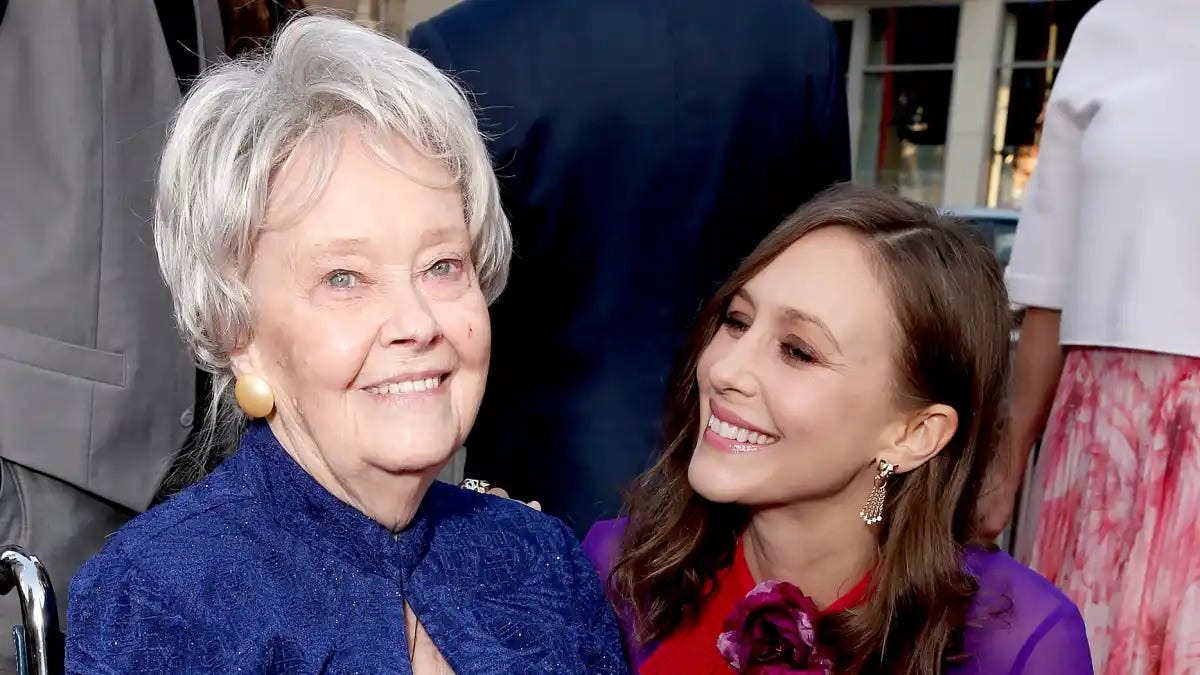
Lorraine Warren wasn’t just a consultant on The Conjuring; she was there. James Wan invited her to the set, where she watched Vera Farmiga channel her younger self. She’d often pull Farmiga aside between takes to share emotional details about the cases that never made it into Ed’s files. Farmiga later said she felt “a responsibility to honor her” and kept a photo of young Lorraine in her trailer.
Lorraine claimed she felt the presence of spirits during filming—specifically during the Annabelle scenes. The cast reported unexplained claw marks appearing on computers, and Patrick Wilson’s hotel room curtains mysteriously caught fire.
That Clapping Game Scene? Improvised.
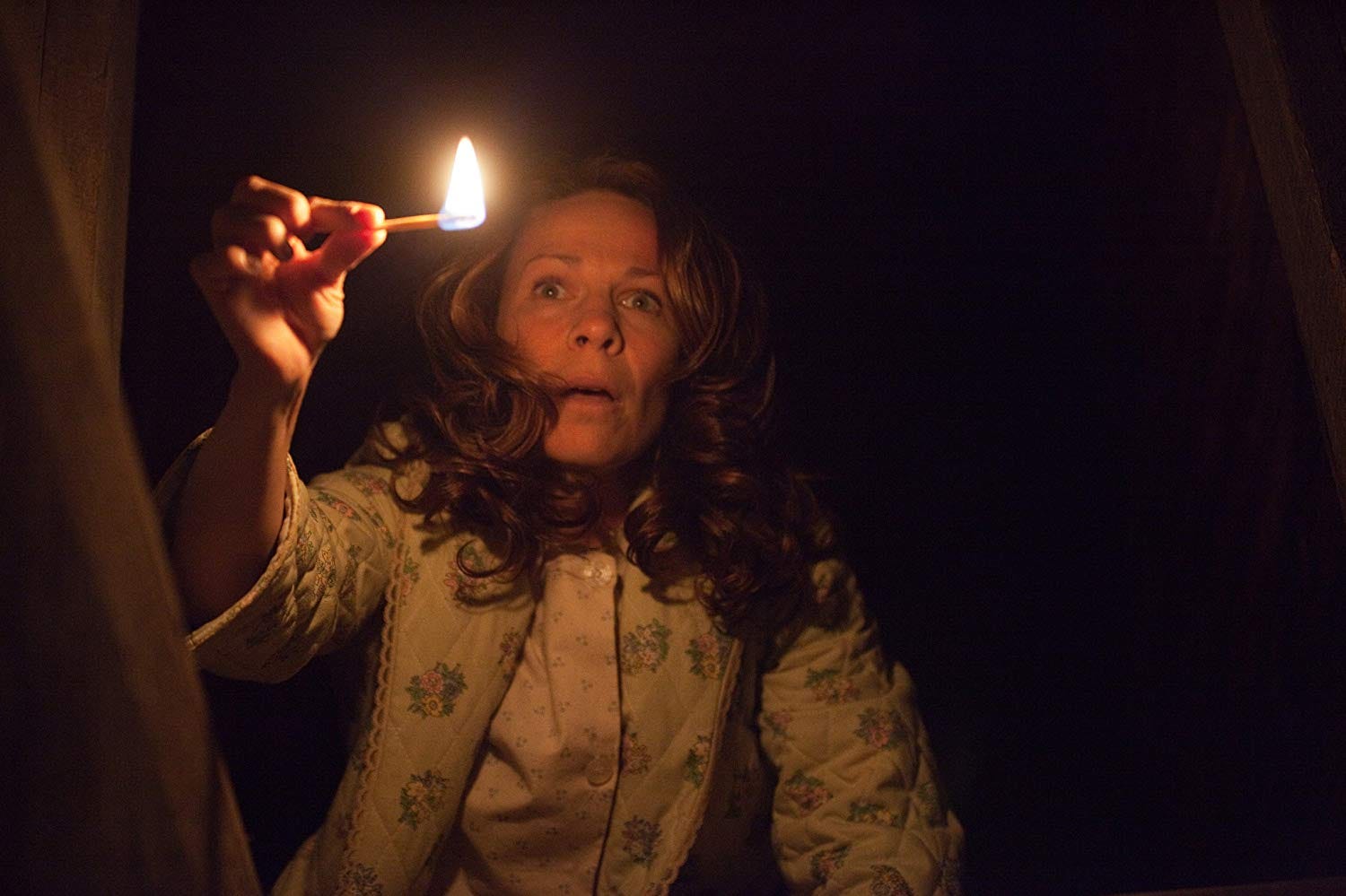
The hide and clap sequence, where Lili Taylor’s character plays a twisted game of Marco Polo with a demon, is the film’s most memorable moment. James Wan told Entertainment Weekly that the scene was barely scripted; he wanted to capture genuine fear, so he had the crew suddenly cut the lights and make noise to disorient Taylor during takes. Her reactions? Mostly real. The rhythmic clapping sound design was inspired by Wan’s childhood fear of hearing footsteps when home alone. The scene took three nights to shoot, and Taylor admitted she couldn’t sleep properly for weeks afterward.
The Props Department Went Full Occult
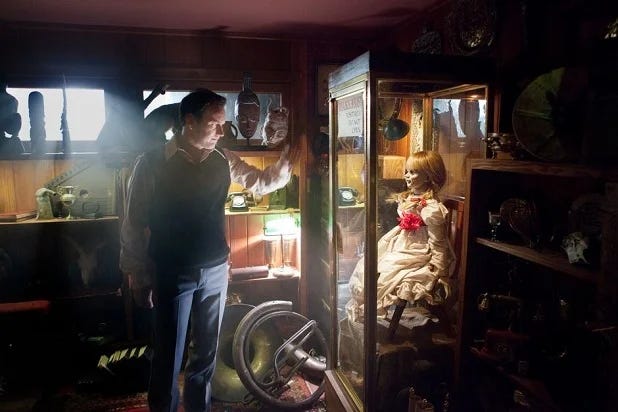
Production designer Julie Berghoff and her team didn’t just dress the Warrens’ basement; they researched it. They visited the real Occult Museum, photographed every cursed object, and recreated many of them for the film’s evidence room scenes. That includes the haunted piano, tribal masks, a shadow summoning mirror, and yes, Annabelle herself. Berghoff told Art of the Title that she wanted the museum to feel “lived-in and obsessively documented.” Hence, they created fake case files, Polaroids with handwritten notes, and religious artifacts that looked genuinely worn from decades of blessing rituals.
The Perron farmhouse set was equally meticulous. Since they couldn’t film the interior of the real house (the owners at the time refused), Berghoff’s team built it from scratch on a soundstage in North Carolina, using blueprints, photographs, and Andrea Perron’s detailed descriptions from her book trilogy. The famous wardrobe that Carolyn hides behind? That was custombuilt to be slightly too small, creating claustrophobia on camera.
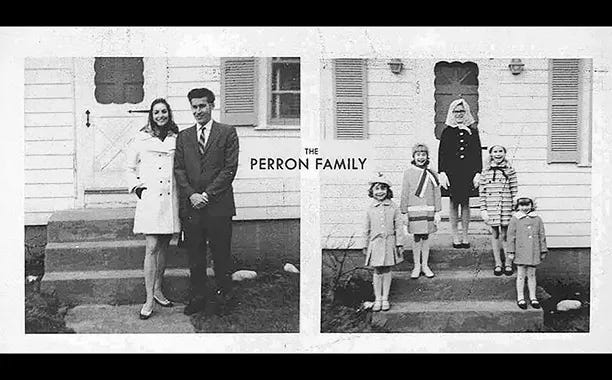
Then there’s the most controversial prop: the photographs of the “real” Perron haunting used in the film’s epilogue. Those aren’t real. They’re staged recreations designed to look like 1970s Polaroids, complete with faked wear and discoloration. It’s a total trick that blurs the line between documentary and fiction, making audiences feel like they’ve seen proof, even though they haven’t.
Visit the “Ghost” House
The Perron family farmhouse in Harrisville, Rhode Island, is real, and according to current owners Cory and Jennifer Heinzen, still very active. They bought it in 2019 and now run paranormal tours, telling The Boston Globe they experience “constant activity”: doors slamming, shadows, disembodied voices. The film shot exteriors in North Carolina. Today, the Heinzens live-stream paranormal investigations on the property. Which you can watch here
Many Youtubers have visited, this is one of the shorter ones.
Rated R for Sustained Terror
In 2013, studios were terrified of R rated horror. The genre was dominated by PG-13 jump scare fare like Insidious (ironically, also directed by Wan). Warner Bros. wanted The Conjuring toned down for a wider audience, but Wan refused. He told The Hollywood Reporter he’d rather make a “pure, uncompromising horror film” than a sanitized cash grab.
The MPAA initially threatened an R rating purely for “sustained terror” not violence, gore, or language, but atmosphere. Wan wore it as a badge of honor.
The Conjuring made $319 million worldwide on a $20 million budget, proving audiences wanted smart, adult horror again. It launched a franchise worth over $2 billion (the highest grossing horror franchise ever). It changed Hollywood’s perception of R rated Horror, leading the way for Hereditary, A Quiet Place, and Get Out.
Annabelle’s “Story”
The actual Annabelle is a Raggedy Ann doll (Isn’t that scarier?), currently locked in a glass case at the Warrens’ Occult Museum in Monroe, Connecticut.
For the film, Wan designed a Victorian porcelain doll because, as he told Vanity Fair, “Raggedy Ann isn’t scary—she’s adorable.” (I disagree). But what’s the real story…
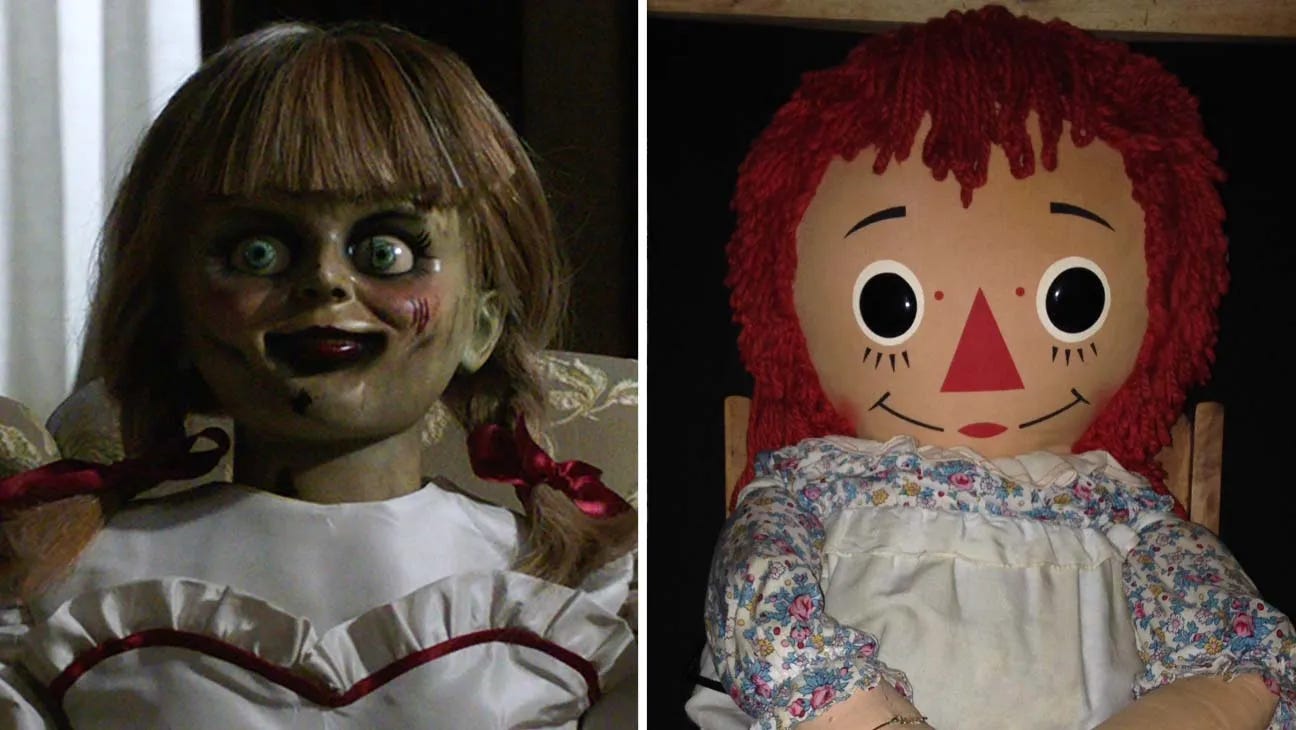
In 1970, a nursing student named Donna received a Raggedy Ann doll as a gift. The doll allegedly started moving on its own, leaving penciled notes saying “Help us,” and was found in different rooms. A medium told Donna the doll was possessed by the spirit of a seven year old girl named Annabelle Higgins, who died on the property. Classic mistake: Donna felt sorry for the ghost child and gave the spirit permission to stay. Things escalated—Donna’s friend Lou claimed the doll attacked him, leaving claw marks on his chest. The Warrens were called in, declared it wasn’t a child but a demon using the doll as a conduit, performed a blessing, and locked it in their museum with a warning: “The doll is not possessed—it’s used as a vessel. A conduit. It doesn’t move on its own. The demonic presence manipulates it.”
According to Lorraine, a nursing student received the doll as a gift in 1970; it began moving on its own and leaving notes that read “Help us.” The Warrens determined it was possessed by the spirit of a girl named Annabelle Higgins (or worse, a demon pretending to be a girl.) Ed Warren warned that the doll was “a conduit” and needed to remain blessed and contained.
Wait, How Much of This Actually Happened?
The Conjuring is a masterclass in selling fiction as fact. The “based on a true story” tagline does a lot of heavy lifting. While the Perron family did live in that farmhouse and reported strange occurrences, and the Warrens did investigate, nearly everything else is an invention.
Start with Bathsheba Sherman, the film’s Satanic child sacrificer. Harrisville town records show she existed, died in 1885, and... that’s it. No evidence of devil worship, no infanticide trial, no suicide by hanging from a tree. Local historian Luann Jodoin told The Providence Journal that “Bathsheba was just a regular woman” whose reputation was posthumously destroyed by the film.
That music box with the creepy spinning mirror? Inspired by a real artifact in the Warrens’ collection (though theirs didn’t predict ghost appearances, that’s pure Wan invention).
The Perrons themselves have been inconsistent: Andrea Perron’s books describe experiences but admit memory gaps and acknowledge the Warrens “embellished” details.
Paranormal investigator Kenny Biddle debunked several Warren claims in Skeptical Inquirer, noting Ed and Lorraine were amateur ghost hunters with zero scientific credentials who conveniently never documented evidence that could withstand scrutiny.
Then there’s the exorcism. Father Gordon J. MacRae, a Catholic priest, wrote extensively about how the Church never sanctioned an exorcism at the Perron house because the Perrons weren’t even Catholic. Wan admitted to Dread Central that the climactic possession scene was “inspired by” multiple Warren cases and “heavily dramatized.”
The Warrens themselves were controversial figures; The Washington Post and The New York Times published investigations questioning their credibility, noting they profited heavily from their “cases” through books, lectures, and museum admission fees. Lorraine claimed spirits followed her everywhere, yet somehow never on camera. Ed died in 2006, Lorraine in 2019, both maintained their stories to the end, but critics argue they were either true believers in their own mythology or masterful self promoters. Maybe both?
Oh and one more thing…Re: Annabelle and the nursing student, Donna, the nursing student has never been publicly identified or interviewed. Lou’s “claw marks” were never photographed or medically documented. The supposed notes saying “Help us” don’t exist in any archive. Skeptical Inquirer’s investigation found zero corroborating evidence beyond the Warrens’ word. Even weirder: the story didn’t appear in print until the mid 1980s, over a decade after the alleged events, in one of Ed Warren’s self published books. No police reports, no hospital records, no witnesses beyond the Warrens’ lecture circuit retellings.
Now here’s the thing, who cares? The movie works because it’s about believers. Not just the Warrens, but the Perrons, the audience, even James Wan himself. In interviews, Wan has said he’s “open to the possibility” of the supernatural, and that ambiguity seeps into every frame. The film doesn’t need to prove ghosts are real. It just needs you to feel what it’s like to believe they might be. That’s why, over a decade later, we’re still talking about it.
NEXT WEEK: PREY
See Paul on tour this week in Boston, DC, NYC (Two Nights) and Philly
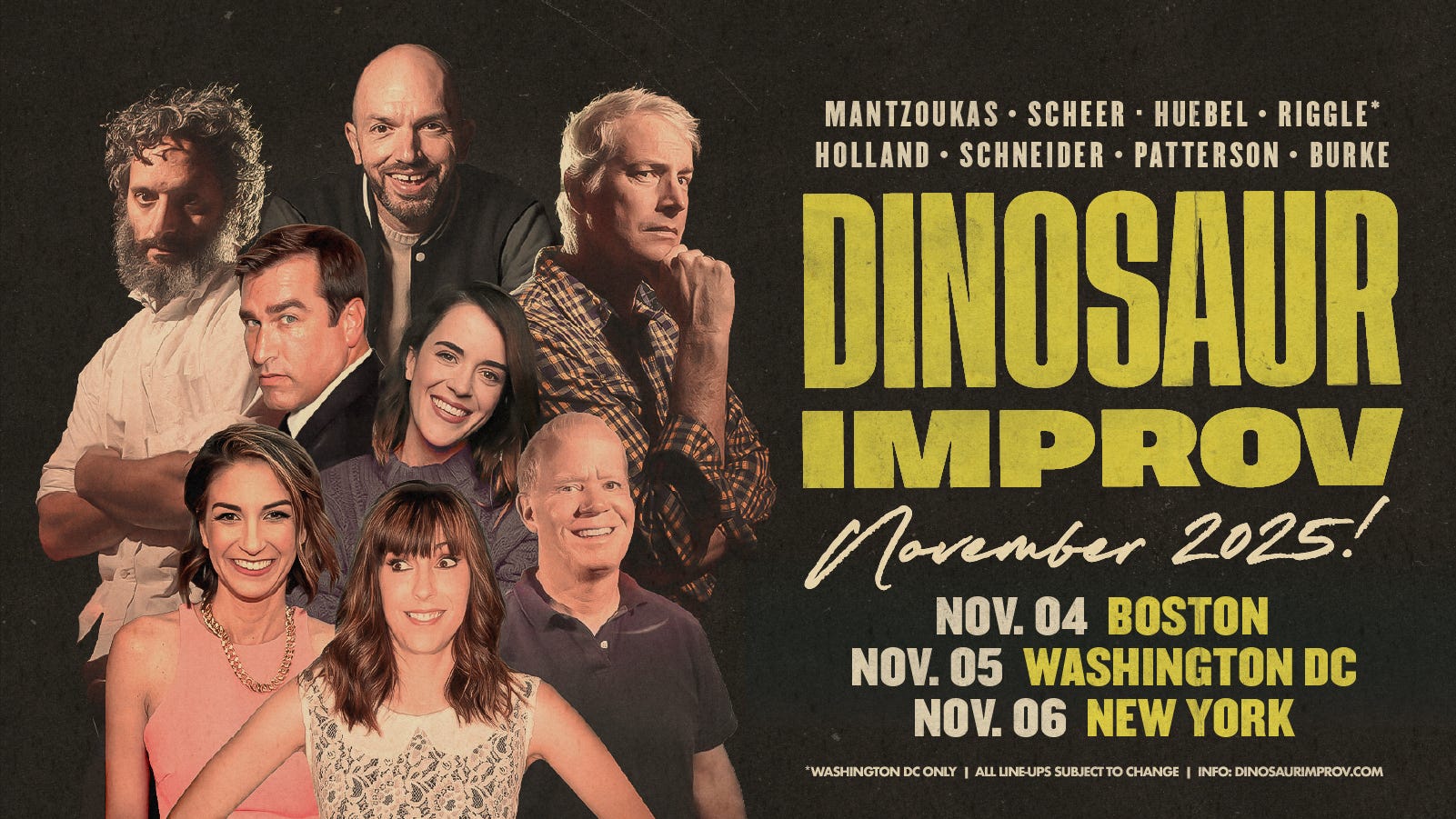
TV stars from The League, Parks and Recreation, The Office, and Righteous Gemstones are coming to your Town for the wildest improv show you’ll ever see.
“I love improv and this show bring some of the best improvisers and comedians for a great show.” - Milford Daily News
“One of the Best Things to do in LA” - LAist
“Our nation’s leading improv geniuses” - Ever Out
“Pretty Fantastic” - Brooklyn Vegan